Published on
October 19, 2026
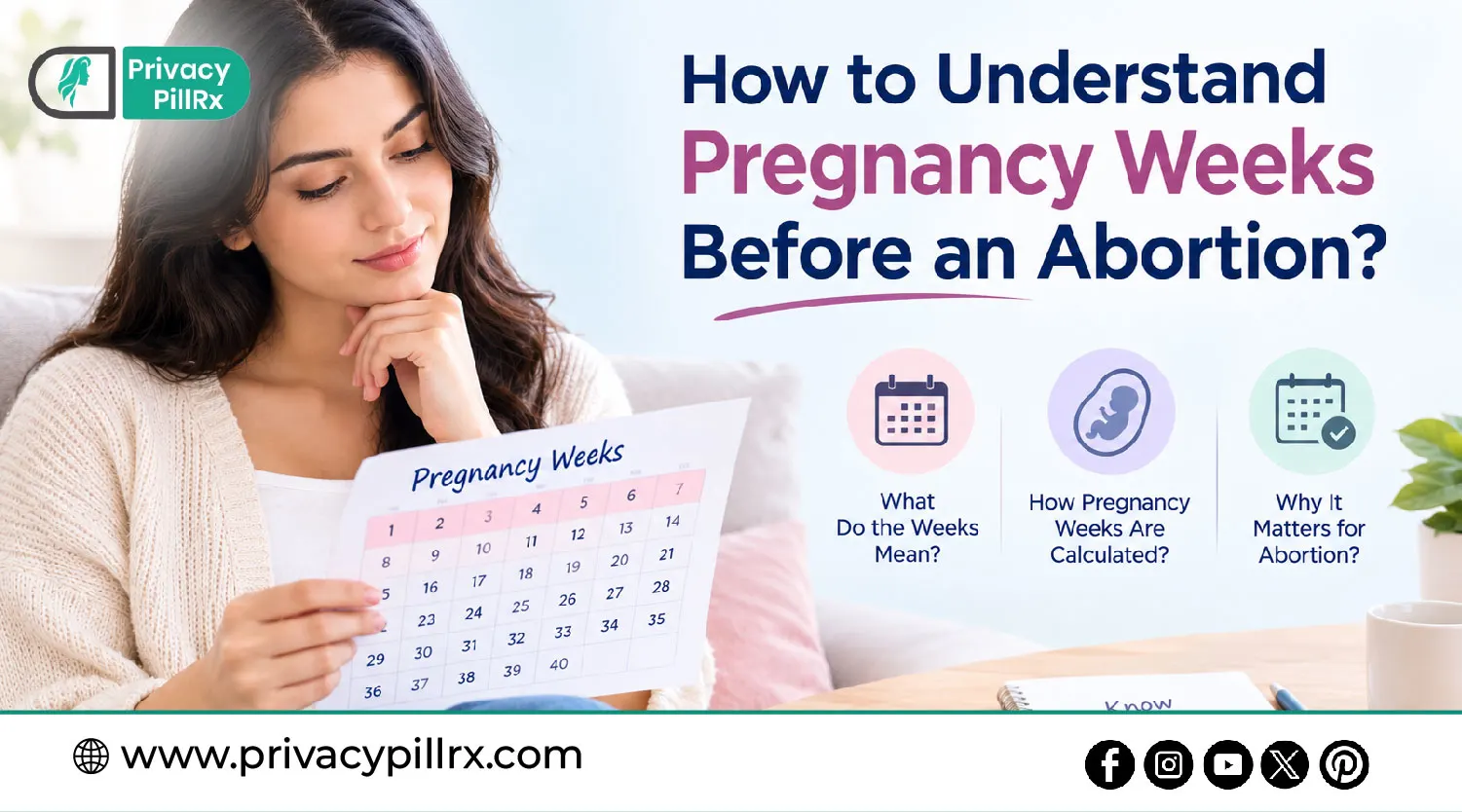
When using abortion pills, it is important to adhere to the dosage instructions, the interval between pills, management of side effects, etc. However, before even starting with the procedure, what many people avoid is to check how far along the conception is i.e. the gestational age. Knowing the pregnancy weeks and duration helps understand if you can undergo medication termination or not.
So, this blog tells you how to measure the pregnancy weeks and why gestational age matters for medical abortion.
Why Knowing Your Pregnancy Weeks Is Essential
When preparing for a pregnancy termination, determine your gestational age:
·
For the pill-assisted procedure, 10 to 12 weeks or 70 to 80 days from the last menstrual period (LMP) is the maximum duration, by which time you must complete using Mifepristone and Misoprostol pills.
·
If the pregnancy is over 12 weeks, you need to undergo a suction or dilation surgical method to end the conception.
·
Knowing the pregnancy phase is not only for general information. Rather, the knowledge helps access safe procedures that are suitable for abortion success.
·
Do remember that abortion laws differ from one region to another, and there may be limitations and capping on the maximum pregnancy weeks allowed until when you can seek pregnancy termination.
Last Menstrual Period vs. Conception – Pregnancy Weeks Calculation
Many believe that pregnancy begins on the day of fertilization or sexual intercourse:
·
However, healthcare professionals consider the gestational age as the actual timeline for pregnancy weeks calculation – counted from the first day of your last menstrual periods (LMP).
·
It is not possible to properly understand when fertilization occurs. However, you may remember the first day of your last menstrual period.
·
In a menstrual cycle, women may ovulate at least two weeks following the start of their period. This is the reason why pregnancy is counted two weeks after the LMP.
·
So, the embryo is already two weeks old, but the pregnancy is said to be 4 weeks old. While a doctor can help you understand the pregnancy weeks, if you want to calculate by yourself count the number of weeks passed from LMP to the current date.
.
If there are extra days after the last week, add that to the gestational age calculation as well.
Pregnancy Weeks Determination for Those With Irregular Cycles
Not every woman may have a 28-day cycle. Some have irregular cycles, so it is difficult to remember the first day of the last period. Thus, calculation of gestational age in these scenarios depending on LMP, often leads to inaccurate estimates. This is where healthcare professionals can assist to confirm the pregnancy weeks. Here are some ways to do so:
·
The most common method is transvaginal ultrasound to note the pregnancy weeks, especially if the conception ranges from 5 to 9 weeks. This scan provides clear visuals of the embryo and sac.
·
The next option is a whole abdomen ultrasound, especially for pregnancy at 8 to 9 weeks. The technician checks the distance from the embryo’s head to the toes or to the bottom to determine the gestational age.
·
Otherwise, the doctor may conduct a general physical examination for the pelvis to understand the uterine firmness and its size to understand the pregnancy’s development.
·
A traditional method is quantitative hCG blood test. While this can tell if you have conceived or not, knowing the pregnancy weeks and location is impossible using this method.
The Different Stages of Early Pregnancy (Weekly Analysis)
Here is a deeper understanding of pregnancy development through the LMP weeks:
·
If you are at 4 weeks LMP, the pregnancy sac is 1-2mm, and quite small to show up in an ultrasound scan. A pregnancy test using a kit at home to check hCG levels yields a positive reading. You may have already missed your last period.
·
By 5 to 6 weeks LMP, a transvaginal ultrasound scan will show the embryo and gestational sac. Since the scan will also detect if the pregnancy is situated in the uterus or outside, it is preferable to rule out ectopic pregnancy risk as the pills can be used for intrauterine pregnancy only.
·
At 8 to 9 weeks LMP, both ultrasound and measurement of the embryo's head to bottom can reveal the presence of pregnancy. Whereas, at 10 to 12 weeks LMP, the efficacy of medical abortion decreases but remains effective nonetheless, but not over this period.
Frequently Asked Questions
Here are the common FAQs about calculating the pregnancy weeks before a medical abortion:
1. How to count the gestational age for pregnancy?
The gestational age is counted from the first day of your last period, even though it happens 2 weeks before pregnancy.
2. Is it safe to use abortion pills without knowing the pregnancy weeks?
No, it is not advisable to undergo medical abortion without knowing if the pregnancy is under 12 weeks or not, as the pill-method is only valid till the specified duration in early conception.
3. Why do women with irregular menstrual cycles depend on ultrasound scans to calculate pregnancy weeks?
Those with irregular cycles cannot depend on LMP to calculate the pregnancy weeks because the ovulation may not follow a fixed pattern each month, thus giving inaccurate calculation. So, an ultrasound scan is more reliable to confirm the pregnancy.
4. Can a home pregnancy test provide an estimate of the pregnancy duration?
These tests detect the presence of the pregnancy hormone, hCG but cannot provide detail of pregnancy weeks and where the embryo is implanted.
5. When is it ideal to undergo an ultrasound pregnancy test to detect pregnancy weeks and location?
For accuracy, an ultrasound scan for pregnancy should be only conducted once 5 to 6 weeks have passed after LMP. It is only then the gestational sac is clearly captured in the visuals, informing about the number of pregnancy weeks and location of the implanted embryo.